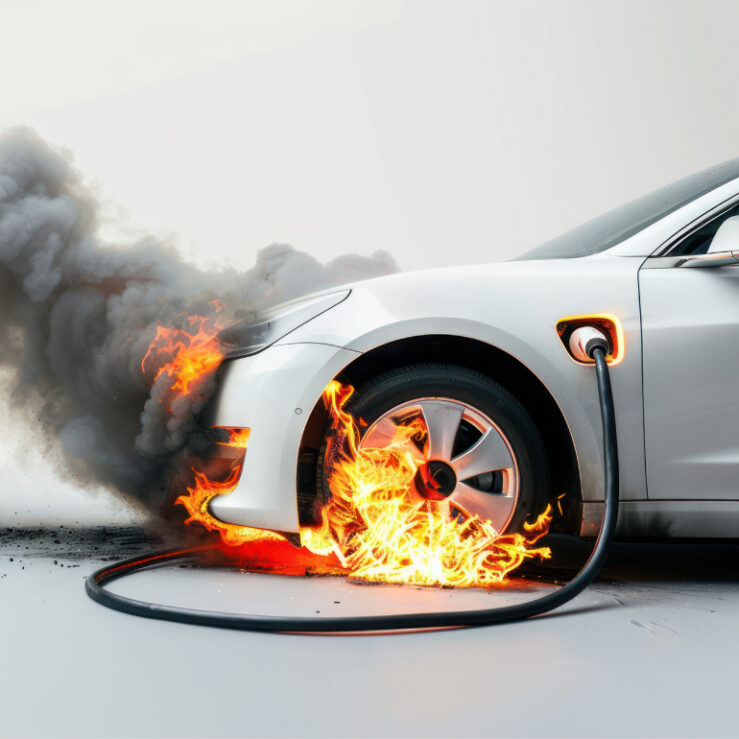
As the UK accelerates its transition toward electric vehicles (EVs) – including cars, vans, electric bikes, scooters and other battery-powered transport – charging infrastructure and lithium-ion battery systems are becoming a permanent feature of commercial environments. From office car parks and logistics hubs to retail centres and mixed-use developments, battery-powered technology is now embedded within the built environment.
While these technologies bring operational and environmental benefits, they also introduce new and evolving fire risks that duty-holders must understand and manage. As we move into 2026, lithium-ion battery safety is no longer a future consideration – it is a current and growing risk that must be reflected within fire-safety strategies.
Why Lithium-Ion Batteries Present a Different Fire Risk
Lithium-ion batteries store large amounts of energy in a compact form. When damaged, poorly manufactured, incorrectly charged, lacking appropriate certification (such as CE marking), or exposed to heat, they can enter thermal runaway; a rapid, self-sustaining chemical reaction that generates extreme heat, fire and the release of toxic gases.
Unlike conventional fires, lithium-ion battery fires:
- Can burn at very high temperatures
- Are difficult to extinguish using traditional methods
- May reignite hours or even days after appearing to be suppressed
This behaviour presents challenges not only for fire-fighting response, but also for detection, evacuation planning and asset protection within commercial premises.
Rising Incident Data
Recent industry data confirms a sustained and significant rise in lithium-ion battery fire incidents across the UK:
- 54% of UK businesses have experienced lithium-ion battery incidents, with one in five reporting fires or explosions, according to Aviva (2025).
- UK fire brigades attended over 1,330 lithium-ion battery fires in 2024, representing a 93% increase since 2022, according to the International Fire & Safety Journal (2024).
While EV fires remain statistically less common than petrol or diesel vehicle fires, the rate of increase, combined with the severity and complexity of lithium-ion battery incidents, makes this an issue that commercial duty-holders can no longer afford to overlook.
Where Commercial Properties Are Most Exposed
EV Charging Infrastructure
EV charging stations introduce sustained electrical loads and extended charging periods, often within enclosed or semi-enclosed spaces such as underground car parks or service yards. Poorly located charging points, inadequate ventilation, or insufficient separation from escape routes can significantly increase risk.
Battery Storage and Ancillary Equipment
Many workplaces now store lithium-ion batteries for fleet vehicles, material-handling equipment, e-bikes and e-scooters, portable tools and backup power systems.
Concentrated storage or charging of multiple batteries increases both ignition risk and fire load, particularly where no dedicated fire-resistant storage or monitoring is in place.
Lack of Risk-Specific Planning
In many cases, lithium-ion batteries have been introduced into buildings without corresponding updates to fire strategies, fire risk assessments or detection systems. This creates a compliance gap under the Regulatory Reform (Fire Safety) Order 2005.
What Duty-Holders Must Do
As regulatory scrutiny around competence, documentation and proactive risk management continues to increase, duty-holders must ensure their fire-safety arrangements reflect emerging ignition risks.
Fire Risk Assessments
Fire risk assessments should explicitly consider:
- EV charging locations
- Battery storage and charging areas
- Electrical loading and infrastructure capacity
- Interaction with escape routes and compartmentation
Generic assessments that do not address lithium-ion battery risks may no longer be sufficient.
Detection and Early Warning
Appropriate detection systems should be installed in areas containing EV charging points or battery storage. Early detection is critical given the rapid escalation potential of battery fires.
Procedures, Training and Emergency Planning
Staff should understand:
- Safe charging and handling practices
- Early warning signs of battery failure
- Emergency response actions specific to battery fires
Emergency plans should be reviewed to ensure they remain appropriate for the risks present.
Future-Proofing Fire Safety
Lithium-ion battery risks are not a temporary trend. As EV adoption and battery-powered technology continue to expand, these hazards will become increasingly common across commercial estates.
Fire risk assessments and appropriate detection systems should be implemented in all areas containing EV charging points, battery storage facilities or e-bike infrastructure. These measures not only support legal compliance but also help future-proof fire-safety strategies against evolving ignition risks.
At Commercial Fire Protection, we support clients by providing structured, practical fire-safety strategies. From fire risk assessments, fire emergency evacuation plans and detection design to compartmentation review and ongoing maintenance, our role is to help duty-holders stay compliant and safeguard people, property and assets.
If your premises include EV charging, battery storage or electrically powered equipment, now is the time to review whether your fire-safety arrangements are still fit for purpose.
Talk to us today to ensure your fire-risk strategy is ready for 2026 and beyond.